
The Rule of Thumb
Most of the time, a garage door that won't open is suffering from something small and cheap to fix — a dead battery, a tripped breaker, a misaligned sensor — not a dead motor or a snapped spring. The exceptions are real, though: if the door feels impossibly heavy when you try to lift it by hand, or if you hear a loud bang before it quit working, you're probably looking at a broken spring or cable, and that's not a DIY job. The trick is checking things in the right order instead of guessing, which is exactly how a technician works through a service call.
What You're Probably Seeing
Before the causes, it helps to match your symptom to the likely category:
- Nothing happens at all — no motor sound, no lights on the opener. Usually power related.
- The opener hums or clicks but the door doesn't move — often a mechanical problem downstream of the motor.
- The door opens a few inches then reverses or stops — almost always a safety sensor issue.
- The door won't move even when you pull the manual release and try by hand — a spring, cable, or track problem.
- The remote doesn't work but the wall button does — a remote or receiver issue, not the door itself.
The Order a Technician Checks
1. Power to the Opener
This is the first thing checked because it's the fastest to rule out. Breakers trip, especially in homes that have been through summer storm season with surges from lightning strikes. GFCI outlets in garages can also trip quietly and cut power without anyone noticing. The fix here is simply resetting the breaker or outlet and confirming the opener's lights come back on. If the opener has a battery backup, a dead backup battery can sometimes cause odd behavior even when main power is fine.
2. Safety Sensors
Next come the two small sensors near the bottom of the tracks. If they're misaligned, dirty, or have a spiderweb or leaf blocking the beam, the opener will refuse to close the door and can behave erratically trying to open it too. After a season of afternoon downpours and the humidity swings common to this part of Florida, sensor brackets can shift slightly, especially if the door has been bumped by a car or a stray basketball. The fix involves wiping the lenses clean, re-aiming both sensors so their indicator lights stay solid, and tightening the mounting brackets.
3. The Remote and Wall Control
If the wall-mounted button opens the door but the remote doesn't, the problem is almost always a dead remote battery or a receiver that's lost its programming — sometimes after a power outage. This is a quick fix: replace the battery, or reprogram the remote to the opener following the manual's reset sequence.
4. The Manual Disconnect
Every opener has a red cord that disconnects the door from the trolley for manual operation. If it's been pulled — by a child, during a power outage, or because someone needed to move a car by hand — the opener will run but the door won't move with it. Reconnecting is simple: pull the cord toward the opener until the trolley re-engages with a click.
5. Springs
This is where things get more serious. Torsion springs above the door, or extension springs along the upper tracks, carry the full weight of the door and wear out from cycling open and closed, typically rated for a set number of cycles. A broken spring usually announces itself with a loud bang at some point before the failure, and afterward the door will feel like dead weight — the opener may strain, click, or reverse immediately because it's trying to lift far more weight than it's built for. Spring replacement is a technician job; the springs are under heavy tension and incorrect handling can cause serious injury.
6. Cables
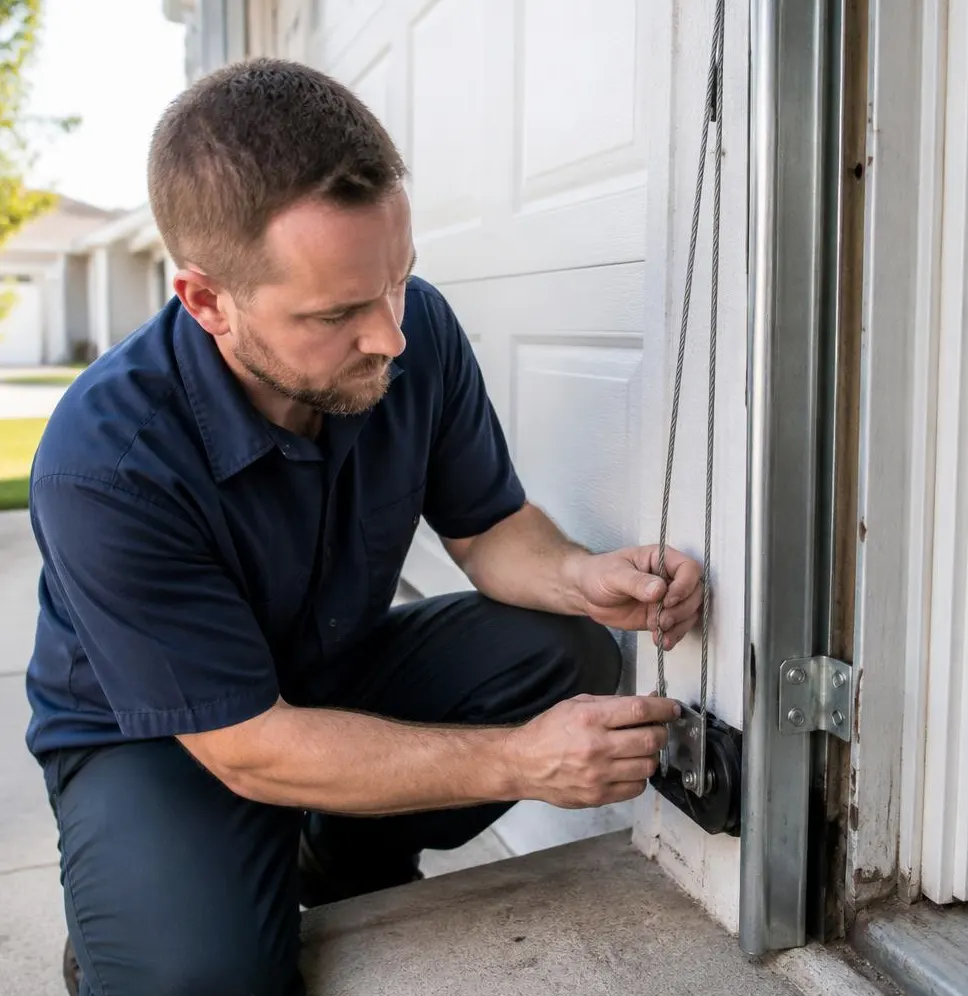
Lift cables work alongside the springs to guide the door's movement. A frayed or snapped cable will often cause the door to hang crooked or drop suddenly on one side. Salt air near the coast and general humidity accelerate cable corrosion faster than in drier climates, so this gets checked right after springs. Replacement means removing tension safely, swapping the cable, and re-balancing the door.
7. Tracks and Rollers
Bent tracks, rust buildup on rollers, or debris lodged in the track can bind the door partway through its travel. Moisture swelling on wood-framed openings and rust on older steel rollers both show up more here than in drier regions. The fix ranges from simple cleaning and lubrication to straightening or replacing a section of track.
8. The Opener Motor and Gears
Last on the list because it's the least common culprit: if everything above checks out and the door still won't move, the opener's internal gear — often a plastic drive gear designed to fail before it damages the motor — may be stripped. A grinding noise with no door movement is the telltale sign. This usually means opener repair or, if the unit is old, full replacement.
When to Call Precision Garage Door of Sopchoppy
If your door feels unusually heavy, won't move even by hand, or you heard a bang before it stopped working, skip the troubleshooting and call us directly — that's spring or cable territory, and it's not safe to handle without the right tools. We also handle off track door repair when storm winds or a stuck roller have pulled the door out of alignment, which is common after the kind of wind-load stress Wakulla County doors see during hurricane season. We'll diagnose the actual cause on-site, explain what's needed before any work starts, and get the door back in reliable working order the same visit in most cases.
If your garage door in Sopchoppy, Crawfordville, Panacea, or anywhere around Wakulla County won't open, call Precision Garage Door of Sopchoppy today and we'll send a technician who checks things in the right order — the first time.